Educational Trip Destinations from Bangalore for School Kids
What if a single day outside the classroom could spark a student’s curiosity for years?
We introduce a curated list of top sites across the city that turn classroom topics into hands-on learning. Our picks include museums, science centers, botanical gardens, planetariums, and wildlife parks that match curriculum goals.
We explain how guided tours and simple activities help students connect theory with real-world examples and boost creativity. Each visit balances clear learning goals, safety, and the right amount of free time so the day stays fun and focused.
We also outline how teacher pre-briefs and post-visit reflections raise the value of the experience. These outings help students ask better questions, work together, and bring fresh ideas back to class.
Why educational trips from Bangalore make learning come alive
Hands-on visits turn textbook facts into moments students remember long after the school bell rings. We see curiosity grow when learners engage with real exhibits, specimens, and demonstrations instead of only reading about them in the classroom.
Active learning beyond the classroom: science, history, and nature
We design outings to match topics in the syllabus so students can test ideas through observation and simple experiments. Direct exposure to museums, gardens, and heritage sites builds skills in inquiry, note-taking, and teamwork.
Planning essentials: age-appropriate sites, safety, and activities
Good planning helps schools run a smooth day. We advise checking transport, meal plans, and emergency contacts, and keeping group sizes manageable for supervision.
- Map sites to curricular goals so teachers can set clear outcomes.
- Prepare short pre-reads and post-visit reflections to boost learning retention.
- Include buffer time for movement, rests, and quick first-aid readiness.
- Use weekdays to reduce crowds and increase interaction at exhibits.
Science and technology hotspots students love
We find a focused science visit helps learners turn theory into action. Short, hands-on sessions make difficult ideas easier to grasp and spark curiosity in topics like motion, energy, and robotics.
Visvesvaraya Industrial & Technological Museum
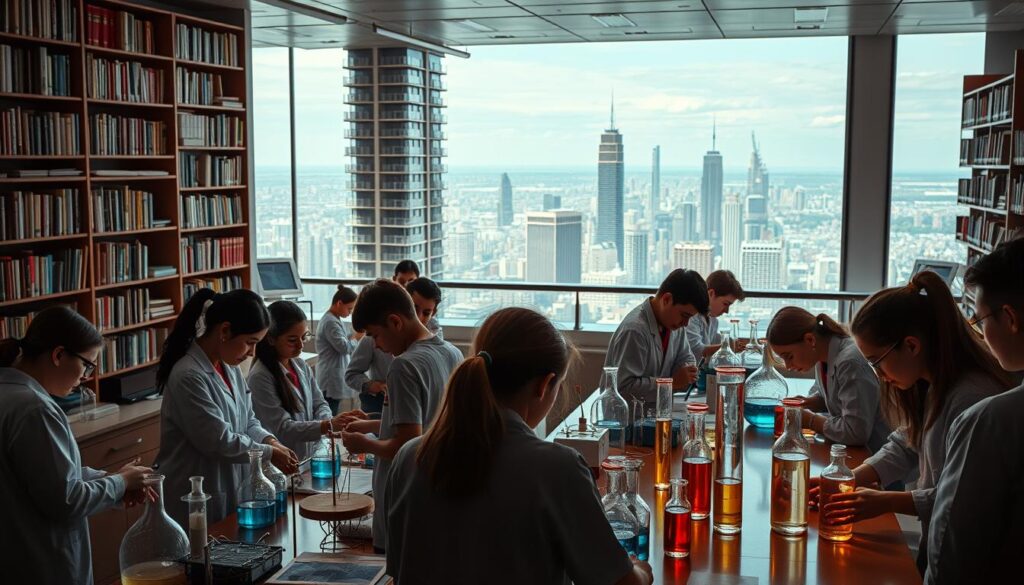
Start at Visvesvaraya Museum for interactive exhibits and experiment stations. Students can join science shows and structured workshops that break down physics, mechanics, and automation.
Live demonstrations and models let learners test formulas and see concepts work in real time.
HAL Heritage Center & Aerospace Museum
HAL’s displays trace aviation history and show full-size aircraft and cockpits. We use these galleries to link aerodynamics and design to classroom topics and to fuel curiosity about engineering careers.
Rail Wheel Factory insights (by arrangement)
A Rail Wheel Factory visit shows production lines, quality checks, and safety systems in action. Such a visit pairs well with GKVK or a science-focused circuit for a full engineering-in-action perspective.
- Align visits with lessons—motion, energy, and robotics fit well.
- Use teacher worksheets to tie exhibits to diagrams, formulas, and problem-solving steps.
- Schedule workshops where available to deepen understanding of key concepts.
Nature and biodiversity in the city’s living classrooms
Our city parks offer real-life lessons that turn casual observation into clear science.
Lalbagh Botanical Garden: plant species, biodiversity, and conservation
We use Lalbagh as a living classroom where students observe many plant species and learn basic taxonomy.
Link learning goals to photosynthesis, pollination, and medicinal plants to make biology concrete.
Plan a loop through the Glass House to discuss seasonal flower exhibitions and horticultural care.
Cubbon Park: urban ecology, trees, and birdlife
Cubbon Park serves as the city’s green lung with diverse trees, birdlife, and small habitats to study.
We have students map microhabitats, identify birds and trees, and compare findings with Lalbagh.
End with quiet observation to appreciate the beauty of landscaped zones and reflect on conservation actions.
- Short mapping exercise: record species, count trees, and note habitats.
- Reflective wrap-up: each student names one species they saw and one action they will take.
| Feature | Lalbagh Botanical Garden | Cubbon Park |
|---|---|---|
| Primary focus | Plant species diversity, Glass House exhibits, conservation lessons | Urban ecology, trees, birdlife, historic monuments |
| Learning activities | Taxonomy walks, medicinal plant talks, pollination demos | Tree ID, bird surveys, habitat mapping |
| Outcomes for students | Understand biodiversity and conservation practices | Recognize urban species and the role of green spaces |
Heritage trails that connect learners to history
Exploring old palaces lets learners read history in carved beams and painted panels. We guide a focused walk that links architecture, art, and politics so students can see how power and taste shaped the city.
Bangalore Palace: architecture, royal art, and the Wodeyar legacy
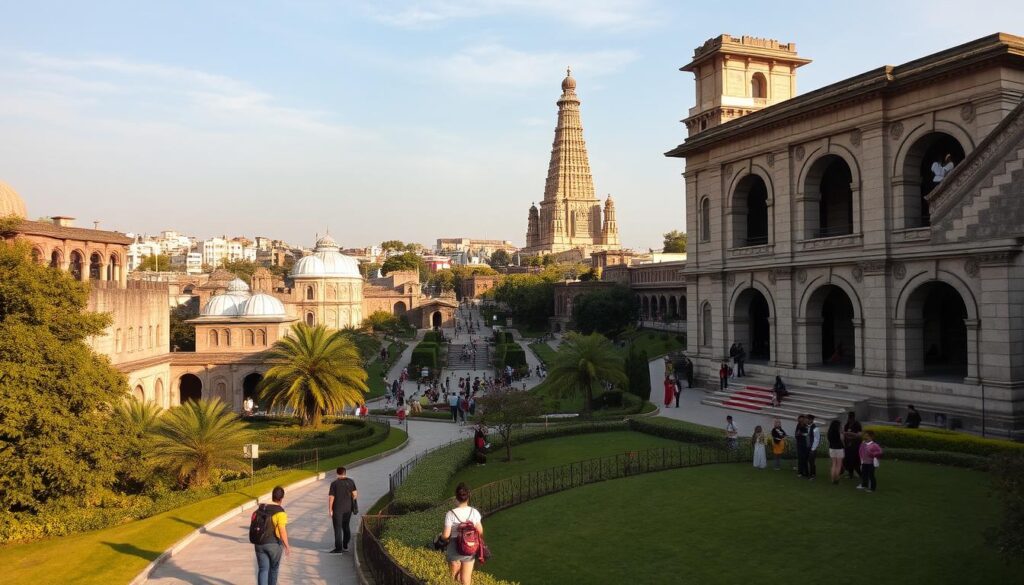
Bangalore Palace (built in 1878) offers ornate interiors and antique furniture that reflect the Wodeyar dynasty’s cultural influence. We ask students to study motifs, woodwork, and room layouts to tie design choices to social status and patronage.
Tipu Sultan’s Summer Palace: teak craftsmanship and colonial-era narratives
Tipu Sultan’s Summer Palace is a teak structure with Islamic details. Its paintings, weaponry, and artifacts open discussion on conflicts with British forces and the period’s political narratives.
- Plan a heritage-focused trip tracing royal art and political history across both places.
- Have students sketch motifs and take notes to strengthen observation and post-visit reports.
- Use short timeline tasks so learners place rulers and events in context and raise questions about change over time.
- Encourage comparison of materials and ruling styles to show the city’s historical evolution.
| Feature | Bangalore Palace | Tipu Sultan’s Summer Palace |
|---|---|---|
| Built | 1878 | 18th century (teak structure) |
| Focus | Royal interiors, Wodeyar art | Teak craftsmanship, colonial-era artifacts |
| Learning outcome | Design and social history | Political narratives and resistance |
Space and astronomy experiences that spark curiosity
Immersive planetarium shows make distant stars and black holes feel concrete and understandable. We use the Jawaharlal Nehru Planetarium to turn big space ideas into clear visuals that feed curiosity.
The planetarium runs dome shows, lectures, and hands-on workshops that cover stars, planets, black holes, and the solar system. Typical hours are about 10 AM-5 PM, and student fees usually range from ₹20 to ₹150 depending on program choice.
Jawaharlal Nehru Planetarium: dome shows, lectures, and workshops
We schedule dome shows to introduce core astronomy topics so students can see constellations and planetary motion in an accessible way. We pair lectures with short activities so learners test ideas from class through guided experiments.
- Align the visit with units on gravity, light, and motion to reinforce science fundamentals.
- Combine lectures and workshops so students practice concepts and ask targeted questions.
- Allow Q&A time after shows to clarify doubts and boost confidence.
- Prepare a pre-visit glossary so students follow exhibits and discussion more easily.
We plan a balanced trip timeline that includes the show, exhibits, and note-taking breaks so every student gains hands-on understanding and lasting interest in space.
Museums that bridge art, archaeology, and natural history
Objects in a museum act like time capsules that help learners connect past practices to present ideas. We use visits to make abstract topics tangible and to spark questions that classrooms alone cannot answer.
Government Museum, Bengaluru: sculptures, coins, and prehistoric relics
The Government Museum is one of India’s oldest places preserving rich history across centuries. Its sculptures, coins, tools, and rare paintings link material culture to wider social concepts.
- We map exhibits to syllabus topics so students link artifacts to classroom concepts.
- Students analyze materials, techniques, and iconography to sharpen observation and interpretation skills.
- We use a simple worksheet: choose one place or artifact and explain what it reveals about trade, belief, or daily life.
- Trips balance note-taking, small-group discussion, and a short post-visit reflection to deepen learning.
| Feature | Focus | Outcome |
|---|---|---|
| Sculptures & coins | Chronology and trade | Understand timelines and exchange |
| Prehistoric tools | Technology and daily life | Link artifacts to human practices |
| Paintings & relics | Belief and art | Interpret iconography and context |
Wildlife and conservation-focused day trips
A focused day at a wildlife park brings biodiversity and conservation into clear view for young learners. We plan visits so students see native species, habitats, and human impacts in one balanced itinerary.
Bannerghatta National Park: safari, zoo, and Butterfly Park
Bannerghatta blends a guided safari, zoo exploration, and a Butterfly Park into a single, hands-on day. Morning slots work best because animal activity is higher and groups move more calmly.
Biodiversity and endangered species: guided learning outcomes
We focus on clear conservation messages: habitats, food webs, and coexistence. Students use observation sheets to note behavior, adaptations, and any endangered status they spot.
- Guided safari for sightings and habitat discussion.
- Zoo stops to compare captive care and wild behavior.
- Butterfly Park for pollination and species diversity lessons.
- Short conservation pledge so students act on what they learn.
| Component | Focus | Best time |
|---|---|---|
| Safari | Habitat viewing, species behavior | Early morning |
| Zoo | Care, adaptation, endangered species | Mid-morning |
| Butterfly Park | Pollination, biodiversity | Late morning |
Pair the visit with a classroom debrief to cement learning. We find this structure gives students a memorable, curriculum-linked wildlife experience.
Outdoor geography and life skills
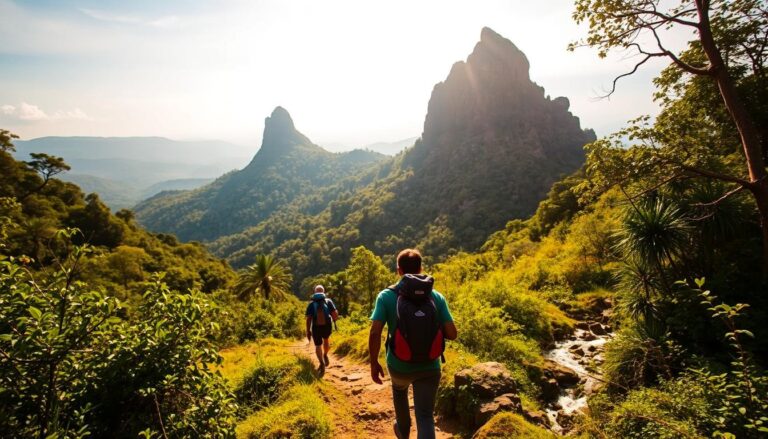
A sunrise visit to a nearby range gives learners a clear view of how terrain shapes human life. We use Nandi Hills as an open-air classroom where geology and teamwork meet practical life skills.
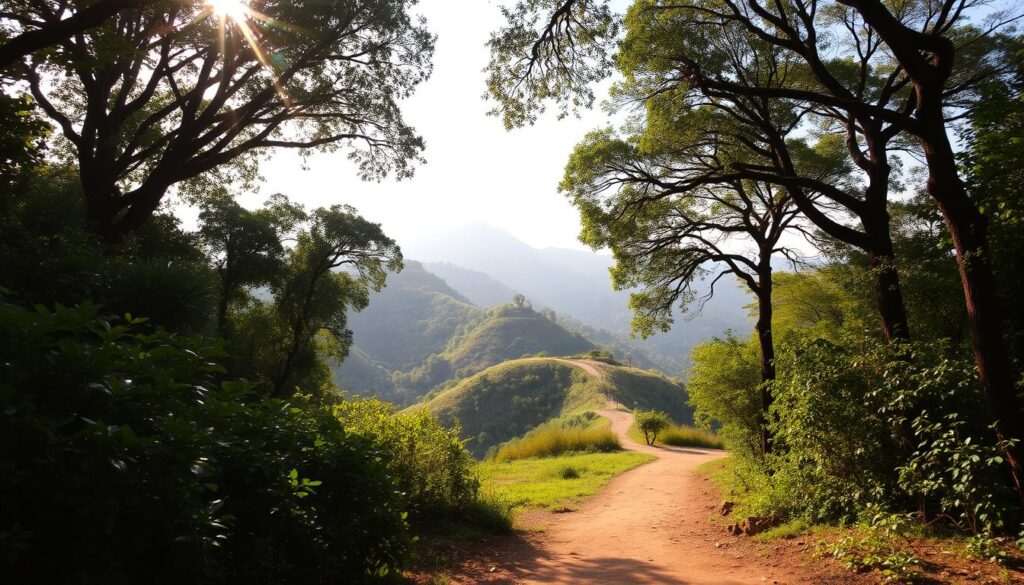
Nandi Hills: landforms, erosion, and teamwork through trekking
We guide students to identify landforms, weathering, and erosion on short walks. Small groups inspect rock layers and note how water and wind shape slopes.
- Simple map-and-compass exercises build navigation and everyday life skills for school groups.
- Short treks include role rotation for leadership, safety checks, and teamwork practice.
- We plan a calm viewpoint stop to enjoy the beauty of the range and discuss how terrain influenced settlement and history.
- Students record field notes and sketches that turn direct observation into class reports.
- Pack recommendations: hydration, layered clothing, and sun protection to keep the day focused on learning.
| Activity | Duration | Learning outcome |
|---|---|---|
| Geology walk | 45 mins | Identify erosion and rock types |
| Map-and-compass drill | 30 mins | Basic navigation and decision-making |
| Viewpoint reflection | 20 mins | Contextualize terrain and human use |
Practical and industrial visits that connect concepts to careers
Seeing production lines and research labs helps learners connect class concepts to careers. We plan circuits that pair food and consumer units, aerospace touchpoints, agri sites, and craft centers so students link theory with real operations.
Food and consumer goods
We arrange factory-style tours at Parle-G, Britannia, Modern Bread, and Mother Dairy. Students observe hygiene, quality checks, and packaging so math and science topics become tangible.
STEM and research circuits
We map ISRO-linked learning with HAL Heritage and Raman Research Institute to show research-to-application pathways. Short workshops or Q&A sessions deepen curiosity and explain career options.
Agriculture, horticulture, and crafts
GKVK and IIHR visits cover plant science, soil tests, and post-harvest handling. Sericulture and organic farms complete the farm-to-table story. Janapada Loka and local clay/toy units show craft livelihoods and design skills.
- Tailor each trip by school level and safety needs.
- Use pre-visit briefs to set learning goals and post-visit projects to reinforce concepts.
- Many operators bundle tours—combine manufacturing with agri modules for richer context.
| Circuit | Focus | Outcome |
|---|---|---|
| Food factories | Production, hygiene, QC | Apply classroom science to processes |
| STEM labs | Research, engineering | Show career pathways in science |
| Agri & crafts | Plant science, heritage skills | Understand livelihoods and sustainability |
educational trips from bangalore: timings, fees, transport, and the best time to visit
Choosing the right season and schedule makes every school outing smoother and more productive. We plan visits so weather, venue hours, and transport align with learning goals and safety needs.
When to go
We recommend October through March for most outdoor and heritage visits. The weather is pleasant and classrooms can continue lessons the next day without weather delays.
Weekdays usually mean lighter crowds. For wildlife-focused days, reserve early morning slots to increase sightings and calm movement.
Typical hours and student fees
Many museums and the planetarium run roughly 10 AM–5 PM. Mid-morning arrivals let students complete exhibits, shows, and short activities in one balanced day.
Budget student fees at about ₹20–₹150 depending on program choices. Always confirm current rates and group discounts before finalising bookings.
Group logistics
- Obtain school permissions and signage-required consents early.
- Lock venue bookings, confirm headcounts, and share emergency contact lists with staff and drivers.
- Arrange suitable buses, tempo travellers, or cabs; note pickup points, parking rules, and return time windows.
- Prepare contingency plans for weather or schedule changes with indoor alternatives to meet learning goals.
| Item | Typical | Notes |
|---|---|---|
| Best season | Oct–Mar | Avoid monsoon for outdoor visits |
| Venue hours | 10 AM–5 PM | Plan mid-morning arrivals |
| Student fees | ₹20–₹150 | Check group discounts and program fees |
Conclusion
A single well-timed visit can link science, history, and nature into a clear learning arc for students. We recommend mixing museum shows, planetarium sessions, garden walks, and heritage sites so each trip builds on the last.
Workshops and astronomy sessions translate hard ideas into hands-on understanding. Outdoor activities teach teamwork, navigation, and observation of living systems.
Wildlife and conservation lessons foster care for animals, trees, and species. Industrial visits make careers and processes visible and relevant to classroom topics.
End every outing with a short post-visit routine: guided reflection, Q&A, and student presentations. Use this guide to pick the right place and time so each school experience delivers beauty, insight, and measurable learning outcomes.